

What Does a Brand Activation Agency Actually Do? Inside the Work Brands Never See
Last updated: July 2026
Most brands do not realize how much work sits behind a live activation until the concept has already been approved, the venue is under discussion, the launch date cannot move, and early production estimates begin exposing everything the initial idea did not account for.
The rendering may not reflect what can actually be fabricated. The venue may prohibit the proposed activity. The product may require storage, refrigeration, replenishment, security, or special handling. The guest experience may create a line without providing anywhere for that line to go. A social moment may look strong on camera while disrupting traffic through the rest of the activation. The budget may include the visible build but exclude labor, freight, permitting, power, staffing, insurance, content capture, installation, or contingency.
By the time these issues surface, the brand is no longer asking an agency to shape the experience. It is asking the agency to rescue it.
That is the work most people never see.
A brand activation agency translates a marketing objective into a physical experience that can be built, staffed, operated, measured, and delivered under real conditions. Depending on the scope, that work may include strategy, creative direction, feasibility, budgeting, venue coordination, fabrication management, vendor sourcing, permits, staffing, logistics, content planning, on-site production, and post-event reporting.
The agency is not simply arranging an event around a logo.
It is building a live operating system around a brand goal.
The Quick Answer: What Does a Brand Activation Agency Do?
A brand activation agency helps a company create a direct, real-world interaction between the brand and its audience.
That interaction may take the form of:
A consumer pop-up
A product launch
A retail or in-store activation
A sampling campaign
A festival footprint
An influencer or media experience
A mobile tour
A hospitality activation
A custom immersive environment
A multi-city experiential campaign
The agency’s job is to determine what the experience should accomplish, how people should interact with it, what is realistically required to produce it, who needs to execute each component, and how the brand will evaluate what happened afterward.
The final activation may last one day. The work behind it can span weeks or months.
Planning a Brand Activation?
Barnastics helps brands and agency partners turn campaign objectives into pop-ups, product launches, retail activations, immersive environments, sampling programs, and multi-market experiences. Explore our Brand Activation services to see how we approach strategy, feasibility, production, staffing, logistics, and live execution.
Why Live Brand Experiences Carry So Much Weight
Brands are investing in physical experiences because a live interaction can establish a kind of credibility that is increasingly difficult to create through passive impressions alone.
In research conducted by Freeman and The Harris Poll, 95% of working professionals said they trusted brands more after attending their events. The same research found that 92% said live events positively influenced how they thought about a company, while 89% said the experience made them feel closer to the brand. Freeman’s 2025 Trust Report provides the complete findings.
That potential does not come from physical presence alone.
A brand does not automatically become more credible because it rented a venue, produced an attractive display, distributed free products, or invited people to attend. Trust is built through the total interaction: how the experience is introduced, whether participation is intuitive, how the staff communicate, whether the product delivers, how the brand handles guests, and whether the environment feels consistent with the promises the brand makes elsewhere.
The activation is a live test of the brand.
When it is thoughtful, people experience the brand as capable, relevant, and human. When it is disorganized, confusing, or visibly underdeveloped, the audience experiences those qualities too.
A Brand Activation Agency Is Not One Vendor
One of the most common misunderstandings is that a brand activation agency is another name for an event supplier.
It is not.
A fabricator may construct the physical environment. An audiovisual company may provide lighting, sound, screens, and technical labor. A staffing company may recruit brand ambassadors. A venue provides the property. A permit expeditor may coordinate filings. A caterer handles food and beverage. A photographer documents the event.
Each partner performs a defined role.
The agency determines how those roles fit together.
That distinction matters because individual vendors can successfully deliver their assigned scopes while the overall experience still fails. The fabricator can build exactly what was approved, the staffing company can send the requested number of people, and the venue can provide the contracted space—but none of those individual deliverables guarantees that the guest journey makes sense, the inventory lasts, the staff know what to say, the content team gets what it needs, or the activation supports the marketing objective.
A brand activation company serves as the strategic and production lead connecting those workstreams into one cohesive experience.
This distinction also affects what a brand should expect during the proposal process.
A vendor can often provide a quote based on a clearly defined request. If a brand needs 10 ambassadors, 500 printed signs, a specific audiovisual package, or a structure fabricated from completed technical drawings, the vendor is pricing a known deliverable.
An agency is usually being asked to solve a much larger problem.
Developing a formal activation proposal may require the agency to assess the campaign objective, interpret the audience, evaluate the concept, identify production risks, recommend the right experience format, map the guest journey, research venues, consider permit requirements, source potential partners, develop preliminary production assumptions, establish a timeline, and determine how the budget should be allocated across multiple workstreams.
That is not simply quoting a service.
It is strategic, creative, and production work.
A detailed formal proposal can represent a significant portion of the agency’s intellectual property and early project development. Expecting an agency to complete that work before being retained can mean asking it to provide the most valuable part of its process—the thinking, planning, feasibility analysis, and execution framework—without compensation.
Some agencies may provide an initial capabilities overview, discuss relevant experience, confirm whether the budget and timeline appear viable, explain its process, and outline a proposed engagement structure. But a fully developed concept, detailed production plan, vendor-backed budget, venue recommendations, or formal execution proposal should generally follow a paid discovery, strategy, or feasibility phase.
This is not about withholding information from the brand. It is about recognizing the difference between evaluating whether an agency is qualified and asking the agency to begin performing the work before a formal engagement exists.
Barnastics is not a vendor responding to a request for a single line item. We are an agency partner responsible for determining how the strategy, creative direction, production requirements, vendors, logistics, staffing, and live execution need to work together.
That responsibility begins before event day—and so does the work.
What “Full-Service” Should Really Mean
“Full-service” does not necessarily mean that an agency owns every warehouse, truck, lighting fixture, printing press, fabrication shop, staffing company, or rental item used in the activation.
It should mean that the brand has one accountable lead overseeing how the complete scope comes together.
A full-service brand activation agency may still hire specialist partners. In many cases, that is the more responsible approach because a technical installation, premium fabrication package, mobile tour, food-sampling program, or union venue may require specialists with very different capabilities.
The value is not that every trade sits under one roof.
The value is centralized ownership.
The brand should know:
Who is protecting the campaign objective
Who is controlling the overall budget
Who is maintaining the production schedule
Who is coordinating approvals
Who is evaluating vendors
Who is identifying gaps between scopes
Who is managing changes
Who is making decisions on-site
Who is responsible for the complete guest experience
Without that leadership, the internal brand team often becomes the de facto production agency while simultaneously trying to manage marketing, leadership approvals, product, communications, retail, legal, and other responsibilities.
The Five Layers Behind a Brand Activation
Although every campaign is different, the work can be understood through five connected layers:
Campaign strategy and audience action
Feasibility, budget, and production planning
Experience architecture and creative translation
Field operations and live execution
Measurement, content, and future optimization
Weak activations often overdevelop one layer while neglecting the others.
A brand may spend heavily on scenic design without establishing an audience action. It may create a strong creative concept without confirming venue feasibility. It may produce a beautiful pop-up without a realistic staffing or replenishment model. It may generate considerable interest but have no way to capture, measure, or continue that interest afterward.
A strong agency keeps all five layers connected.
Layer One: Campaign Strategy and Audience Action
The first responsibility of a brand activation agency is not to select furniture, locate a venue, or produce a rendering.
It is to establish what the activation must accomplish.
Possible objectives include:
Introducing a new product
Driving product trial
Entering a new city or customer market
Increasing retail traffic
Supporting a store opening
Educating consumers
Capturing qualified leads
Generating press or creator content
Building a brand community
Supporting a sponsorship
Collecting customer feedback
Strengthening loyalty
Producing content for a larger campaign
Influencing purchase or post-event action
An activation can support more than one goal, but it cannot prioritize everything equally.
A concept built primarily for rapid sampling will function differently from a product-education experience. A media preview has different timing and hospitality requirements than a public street activation. A retail experience intended to drive conversion must respond to shopper behavior, inventory, store operations, and the existing sales environment.
The agency helps the brand determine which action matters most.
Moving From “What Should It Look Like?” to “What Should People Do?”
Creative conversations often begin with appearance:
What should the space look like?
What colors should be used?
What kind of installation would attract attention?
What would make a good photo moment?
Those questions matter, but they come after a more important set:
Why should someone approach?
What should immediately make sense?
What should the person do first?
Where does the product enter the interaction?
What information should the person understand?
What action should happen before the person leaves?
What should continue after the event?
The best concepts make participation easy to understand without stripping the experience of discovery.
The Association of National Advertisers identifies having a clear purpose, designing around customer needs, involving PR early, creating digital scalability, and developing an immersive interaction as foundational activation practices. ANA’s event and experiential marketing research reinforces that the experience should begin with the customer objective—not a collection of disconnected tactics.
The Audience Context Changes the Idea
A person encountering an activation while shopping behaves differently from someone attending an invitation-only launch.
Festival attendees may be willing to wait or participate longer, but the brand is competing with entertainment, sponsors, food, friends, and the rest of the event. A commuter may only provide a few seconds of attention. A luxury guest may expect quieter pacing, personal service, and a more edited environment. A retail shopper may be close to purchase but resistant to anything that slows the shopping trip.
The agency evaluates the audience within the actual context—not only through broad demographic labels.
That context affects the message, footprint, operating hours, staffing style, incentive, product quantity, throughput, content plan, and appropriate level of interaction.
Layer Two: Feasibility, Budget, and Production Planning
A creative idea is not ready for production because it looks complete in a presentation.
It becomes production-ready after the agency has pressure-tested what will be required to deliver it.
What a Feasibility Review Examines
Depending on the activation, feasibility may include:
Market and venue realities
Footprint dimensions
Guest capacity
Traffic and queue behavior
Public or private property requirements
Permitting jurisdiction
Fire and life-safety requirements
Accessibility
Weather exposure
Power and internet access
Sound restrictions
Product storage
Food or beverage handling
Installation access
Freight-elevator dimensions
Loading and parking
Union labor requirements
Security
Insurance
Structural engineering
Technology integration
Staffing availability
Inventory and replenishment
Client approval timing
These are not administrative details added after the creative work.
They shape what the creative can become.
A venue may permit a pop-up but prohibit amplified sound. An outdoor property may approve the footprint but not allow ground anchoring. A retail location may require installation after operating hours. A food product may need refrigeration and licensed handling. A custom structure may require engineering, fire treatment, ballast, or an inspection. A media event may need protected camera positions that consume more floor area than expected.
Feasibility identifies those realities before they become emergency expenses.
A Rendering Is Not a Fabrication Package
A rendering communicates how the experience is intended to appear.
It does not necessarily tell a fabricator how to build it.
Production development may still require:
Verified dimensions
Material selections
Finish specifications
Construction details
Structural connections
Power paths
Hardware
Graphic measurements
Code considerations
Technical integration
Shop drawings
Engineering
Installation methodology
Packing and transportation plans
This distinction becomes particularly important when a concept has been developed before the production agency is engaged.
The agency must determine which elements can be built as shown, which need technical development, where value engineering may be appropriate, and whether the approved investment can realistically support the expected finish.
The Budget Must Reflect the Complete Experience
The visible build is only one portion of an experiential marketing budget.
A complete budget may also include:
Agency strategy and production management
Creative development
Venue or footprint fees
Fabrication
Graphics
Rentals
Lighting and audiovisual production
Technology
Staffing
Product specialists
Security
Catering or hospitality
Permits
Insurance
Freight
Storage
Travel
Installation and strike labor
Content capture
Cleaning
Waste management
Reporting
Contingency
This is why a standalone fabrication quote, venue estimate, or staffing proposal cannot be treated as the full activation cost.
For a deeper breakdown by format and scale, Barnastics’ 2026 experiential marketing activation cost guide explains how budgets differ across sampling campaigns, pop-ups, immersive launches, mobile tours, and festival activations.
The agency’s responsibility is not to make every initial idea fit by removing invisible essentials. It is to identify the strongest execution path the budget can support.
Have a Concept but Not a Complete Production Plan?
Barnastics can evaluate the idea, audience, market, venue requirements, timeline, working budget, and production realities before the project moves into execution. Start a Project Inquiry with the information currently available.
Layer Three: Experience Architecture and Creative Translation
Once the objective and feasibility are understood, the agency can shape the audience experience.
This is where brand strategy becomes physical behavior.
The Guest Journey
A complete guest journey may include:
Attraction: What makes the intended audience notice and approach?
Orientation: How does someone understand what the experience is and whether it is for them?
Entry: Is participation open, ticketed, invitation-only, scheduled, or controlled through a line?
Engagement: What is the primary interaction with the brand or product?
Education: What should staff, signage, programming, or technology explain?
Capture: Is the brand collecting data, feedback, content, purchases, scans, or another measurable action?
Share: Is there a reason for someone to photograph, record, or discuss the experience?
Exit: What does the guest receive, understand, or do next?
Not every activation needs a station for each step. In a well-designed experience, one interaction may accomplish several functions.
A product customization moment can create dwell time, product education, content, and a personalized takeaway. A guided tasting can create trial, conversation, feedback, and purchase intent. A strong immersive installation can attract attention, establish an emotional association, and lead people into a measurable digital interaction.
The important point is that the journey is intentional.
Designing for Throughput and Depth
More participation is not always the same as better engagement.
An activation must balance two variables:
Throughput: How many people can participate within the available time?
Depth: How meaningful is each interaction?
A sampling cart may prioritize high throughput. An intimate product consultation may prioritize depth. A festival installation may need both: a fast exterior interaction for a large crowd and a deeper experience for those willing to enter.
The agency models how long each interaction takes, how many staff members are required, where people will wait, how inventory will be replenished, and what happens when demand exceeds expectations.
This is one of the areas where an attractive concept can fail operationally. If the interaction requires four minutes but the experience can only serve ten people at a time, the campaign may need a reservation system, more stations, a shortened interaction, or a different footprint.
Content Should Be Designed, Not Merely Documented
Many brands want the activation to produce photos, creator content, media assets, or social amplification.
That requirement needs to influence the experience early.
Content planning may affect:
Lighting
Camera positions
Backgrounds
Logo visibility
Human scale
Sound
Guest privacy
Release requirements
Timing
Product placement
Staff behavior
Crowd management
Dedicated shooting windows
Creator access
Post-production deliverables
A photo opportunity added to the side of an activation does not automatically create useful content.
The strongest moments give people a natural reason to participate while allowing the brand to remain recognizable in the resulting image or video.
Layer Four: Field Operations and Live Execution
The public only experiences what happens live.
Months of strategy and creative work can be weakened within minutes by missing inventory, unclear roles, poor line management, incomplete staff training, delayed vendors, technical failure, or a guest flow that does not behave as expected.
That is why field operations are part of the experience—not separate from it.
The Production System Behind Event Day
A brand activation agency may develop or coordinate:
Master production schedules
Budget trackers
Vendor scopes
Approval schedules
Site plans
Equipment lists
Contact sheets
Staffing plans
Training materials
Brand talking points
Inventory trackers
Product-replenishment plans
Load-in schedules
Installation sequencing
Technical testing
Run of show
Emergency procedures
Weather plans
Escalation protocols
Strike and removal schedules
These documents are not paperwork for its own sake. They reduce uncertainty and give the team a shared operating plan.
Vendor Coordination Is More Than Forwarding Emails
Vendor management involves evaluating capabilities, comparing scopes, identifying exclusions, coordinating dependencies, controlling approvals, tracking payments, confirming schedules, and ensuring that one partner’s decision does not disrupt another’s work.
For example:
The fabricator needs final graphics before production.
The graphic dimensions depend on approved shop drawings.
Shop drawings depend on verified venue dimensions.
Venue dimensions may need to be confirmed during a site visit.
The site visit may reveal a smaller load-in path.
The smaller load-in path may require the structure to be produced in additional pieces.
That change may affect labor, installation time, seams, transportation, and cost.
This is why experiential event production cannot be managed as a collection of unrelated purchases.
The work is interconnected.
Staffing Is a Brand Decision
Brand ambassadors, product specialists, registration staff, hospitality teams, and on-site managers are often the most direct human representation of the brand.
They need more than arrival instructions and a branded shirt.
A complete staffing plan may address:
Role profiles
Required experience
Appearance standards
Product knowledge
Brand language
Prohibited claims
Guest-service expectations
Shift timing
Break coverage
Lead responsibilities
Escalation
Data capture
Inventory handling
Opening and closing procedures
The agency should also determine how many people are required based on the interaction—not simply the size of the venue.
A large footprint may need relatively few staff if the experience is self-guided. A small product trial may need more people because every guest requires education, sanitation, replenishment, or data capture.
Live Production Requires Decision Authority
An on-site agency lead needs to know which decisions can be made immediately and which require client approval.
That can include:
Opening distribution early because demand has begun
Temporarily pausing an interaction
Redirecting the line
Reallocating staff
Adjusting inventory release
Moving signage
Modifying the schedule
Protecting talent or VIP movement
Responding to weather
Removing a malfunctioning element
Escalating safety concerns
The agency’s job is not to pretend that nothing unexpected will happen.
It is to prepare the team to respond without losing control of the experience.
Barnastics Case Study: Reformation Chicago Summer Popsicle Activation
On July 11, 2026, Reformation activated at North Avenue Beach in Chicago with a stationary frozen-treat cart, branded merchandise, and a complimentary beachside giveaway.
The primary objective was brand awareness. The experience was intentionally designed as a simple, fast-moving interaction that placed Reformation-branded merchandise and frozen treats directly into the hands of consumers in a high-traffic summer environment.
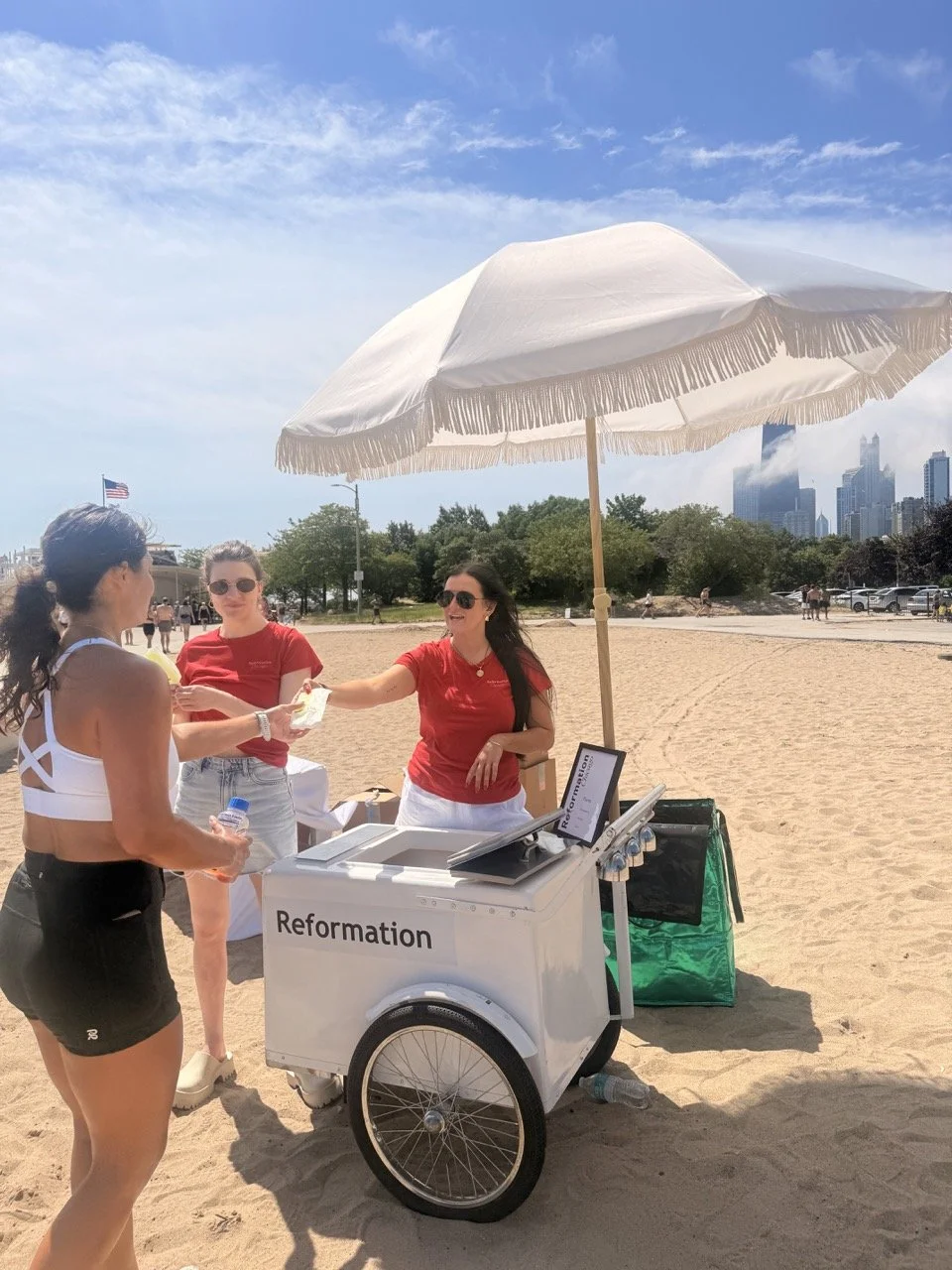
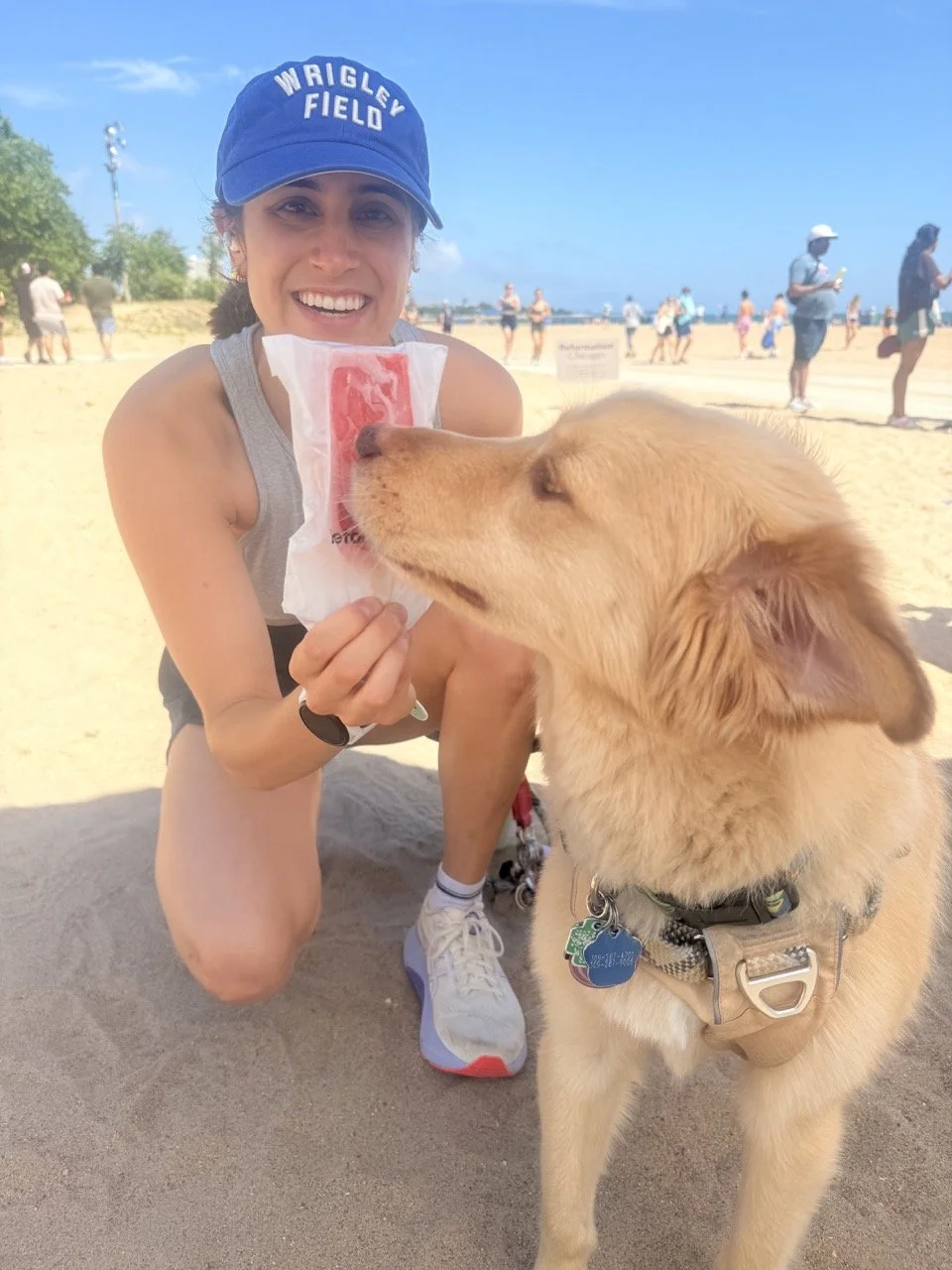
Interest began while the team was still setting up, prompting distribution to begin at 10:25 a.m., ahead of the scheduled 11:00 a.m. opening. All branded merchandise was distributed by approximately 10:40 a.m., and all 275 frozen treats were gone by 11:00 a.m.—the activation’s official start time.
The product moved at an estimated rate of approximately eight units per minute.
From an immediate visibility and demand perspective, the activation delivered several positive results:
The beachfront location generated organic consumer interest without requiring a complicated participation mechanic.
The offer was immediately understandable.
The Reformation branding was visible throughout the product handoff.
The merchandise and frozen treats created a simple, photogenic consumer moment.
Every available item was distributed.
Demand was strong enough to consume the entire inventory ahead of the planned operating window.
There was no idle time or missing engagement step within the approved experience. Guests were meant to receive branded merchandise and a frozen treat, then continue enjoying the beach. Because the activation was structured as a quick consumer handoff, there was no larger environment, extended programming, or secondary activity intended to keep people at the footprint.
A redemption card was also included as part of the broader campaign. However, that component was not created, managed, or tracked by Barnastics, so we did not have access to redemption data or any resulting consumer behavior.
The activation demonstrates what a streamlined awareness program can accomplish. It created immediate attention, put branded items into circulation, and introduced Reformation to consumers in a contextually relevant setting.
It also demonstrates how budget and scope influence the scale of an activation.
The approved investment supported a stationary cart, branded merchandise, and 275 frozen treats. It did not extend to a larger branded environment, greater inventory, additional programming, a deeper consumer interaction, or measurement tools managed by Barnastics. As a result, the experience created a concentrated burst of visibility rather than a sustained three-hour brand presence.
That distinction is important when evaluating awareness campaigns.
Immediate consumer attention and complete inventory distribution are meaningful indicators of interest. However, they are not the same as measured brand lift. Without an audience survey, controlled brand-awareness study, trackable digital action, or access to redemption data, it would be irresponsible to claim that the activation produced lasting changes in brand recognition or purchase intent.
A future version could build on the demonstrated demand through:
More inventory aligned with the expected traffic and operating window
A larger branded footprint with stronger visibility from a distance
A secondary interaction that communicates more of the brand story
Ambassador messaging designed around specific awareness points
A measurable QR code, retail offer, or audience-capture mechanic
Integrated access to redemption and post-event data
Additional content moments that extend the activation beyond the people physically present
The lesson is not that every awareness activation needs to become an expensive immersive experience.
The lesson is that the investment, inventory, environmental presence, operating window, and measurement plan should align with the type of awareness the brand wants to generate. A lean giveaway can create an immediate and efficient moment of visibility. A larger investment creates the opportunity for sustained presence, deeper engagement, greater reach, and more defensible measurement.
Layer Five: Measurement, Content, and Future Optimization
Measurement begins before the activation.
The brand and agency need to determine what evidence will indicate that the campaign worked and what systems are required to collect it.
Possible Brand Activation Metrics
Depending on the objective, measurement may include:
Foot traffic
Qualified interactions
Participation rate
Samples distributed
Demonstrations completed
Inventory depletion
Dwell time
QR-code scans
Email or SMS opt-ins
App downloads
Survey responses
Content created
Social posts
Engagement with creator content
Earned media
Promotion redemptions
Retail traffic
Purchases
Leads
Cost per engagement
Post-event brand lift
Customer feedback
The metric should match the objective.
A sampling campaign should not be judged solely by photography. An immersive installation should not necessarily be reduced to product distribution. An influencer experience may have a small guest count while generating a much larger content audience. A retail activation may need to connect engagement to store traffic or conversion.
Event Marketer describes EventTrack 2026 as an industry benchmark based on insights from more than 1,000 Fortune 1000 marketers and event attendees across business-to-consumer, business-to-business, and trade-show sectors. Its continued focus on measurement reflects how far the field has moved beyond reporting attendance alone. Event Marketer’s current research library includes EventTrack and additional measurement studies.
Measurement Must Be Operationally Possible
A brand may say it wants lead capture, but the experience still needs:
A reason for guests to provide information
A device or QR system
Reliable internet or offline capability
Appropriate consent language
Staff instructions
A plan for avoiding bottlenecks
Data ownership and integration
A follow-up workflow
The same applies to content, surveys, product redemption, app downloads, and sales attribution.
Measurement is not a label placed on the recap deck. It is a production requirement.
A Second Proof Point: The Oracle at ARC Festival Chicago
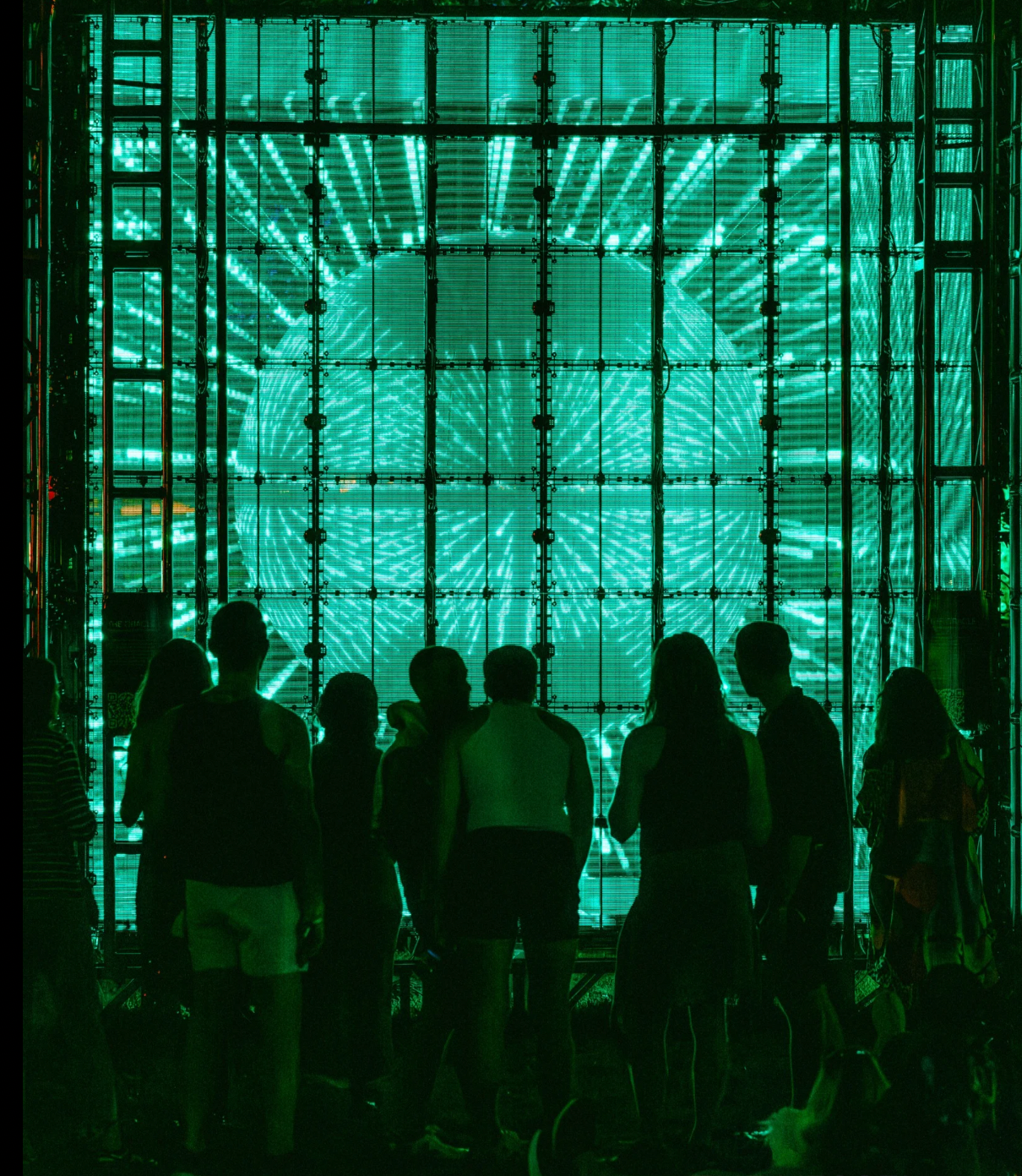
The Oracle, featured in Barnastics’ immersive work portfolio, used LED mesh, projection-based visuals, audience movement, QR engagement, and a custom web experience to create a participatory installation at ARC Festival Chicago.
The project generated more than 10,000 unique interactions and a reported 15% attendee engagement rate through its integrated QR component. View The Oracle case study.
This illustrates a different activation model from rapid product distribution.
The physical installation created attraction and emotional impact. The digital component gave the audience a defined way to participate and provided a measurable action. Neither layer existed as an afterthought.
The objective, creative environment, technology, and measurement system reinforced one another.
Single-Market and Multi-City Activations Require Different Systems
A successful activation cannot always be copied into another city without modification.
A multi-city brand activation may need consistency in its core idea while adapting:
Venue format
Footprint
Permits
Labor
Audience behavior
Weather
Transportation
Staffing
Local partners
Cultural context
Inventory
Operating hours
Production costs
Market-specific messaging
The agency must decide what remains fixed and what can flex.
What Usually Remains Fixed
The brand standards, campaign objective, primary interaction, key talking points, measurement framework, training expectations, and recognizable visual system should generally remain consistent.
What May Need to Change
The footprint, materials, layout, staffing level, permit strategy, line plan, schedule, product quantity, venue type, or supporting programming may need to change by market.
A rigid system may fail because it ignores local realities.
An overly flexible system may become inconsistent and expensive.
The agency’s job is to develop a repeatable production model with clearly defined adaptation points.
This is especially important for consumer brands launching in several cities, retailers activating across multiple stores, agencies seeking local execution partners, and international teams entering U.S. markets without established production relationships.
What a Brand Activation Agency May Coordinate
Depending on the approved scope, brand activation services may include:
Strategy and Feasibility
Campaign-objective development, audience planning, format recommendations, market assessment, preliminary feasibility, budget alignment, and production-path recommendations.
Creative and Experience Development
Concept development, creative direction, guest-journey planning, spatial strategy, content moments, brand integration, environmental direction, and programming.
Venue and Location Support
Venue research, site evaluation, location coordination, technical review, site visits, footprint planning, access review, and communication with the property or event organizer.
Production and Fabrication
Vendor briefs, scenic coordination, technical development, shop-drawing review, fabrication oversight, graphics, rentals, audiovisual production, quality control, installation, and strike.
Staffing and Guest Operations
Staffing models, brand ambassadors, specialists, managers, training, registration, line management, inventory support, hospitality, and guest-service procedures.
Logistics and Compliance
Permitting coordination, insurance requirements, freight, storage, delivery, travel, parking, loading, security, sanitation, and waste removal.
Content and Measurement
Photography, video, creator requirements, QR systems, lead capture, surveys, reporting, campaign metrics, post-event recap, and future recommendations.
Not every project needs every service.
The agency should build the scope around the campaign rather than forcing the campaign into a standard package.
What May Be Priced Separately or Managed by Other Partners
Brands should also understand what may sit outside the agency’s base scope.
Depending on the engagement, the following may be separate services, third-party expenses, or responsibilities retained by the client or another agency:
Paid media
Public relations
Guaranteed media coverage
Influencer contracting
Talent fees
Product manufacturing
Product shipping from the client’s warehouse
Legal review
Trademark or claim approval
Customer-data compliance
Retail sales attribution
Venue rental
Fabrication costs
Staffing costs
Government fees
Photography usage rights
Travel
Security
Insurance
Post-event paid amplification
The exact ownership should be documented before production begins.
One of the fastest ways to create budget conflict is to allow every party to assume that someone else has included a required workstream.
When an Event Vendor Is Enough
Not every live marketing project requires a full experiential marketing agency.
A direct vendor relationship may be sufficient when the brand already has:
An approved strategy
A completed creative concept
Final technical specifications
A confirmed venue
A complete budget
An internal producer
A staffing plan
A measurement system
A clear division of responsibilities
The capacity to coordinate all partners
Internal event team
For example, a brand with final fabrication drawings and an experienced internal production team may only need a fabricator. A company with an established sampling program may only require local staffing. A retailer may only need a specific display installed.
The need for an agency increases when the project still contains unresolved questions across strategy, feasibility, creative, production, staffing, logistics, or measurement.
Signs Your Brand Needs an Agency Lead
A brand activation agency is likely appropriate when:
The project is tied to an important launch or market entry.
The concept still needs to be translated into a realistic scope.
Several vendors or markets must be coordinated.
The experience includes custom fabrication.
The venue has complex requirements.
Product trial or sampling requires operational planning.
PR, creators, content, or VIP guests add another production layer.
The activation needs measurable audience action.
The internal team does not have a dedicated experiential producer.
The date is immovable and the cost of failure is high.
The campaign needs to maintain consistency across cities.
Leadership expects agency-level oversight and reporting.
The deciding factor is not simply the guest count.
A 75-person press launch can require more strategic and operational control than a public sampling program reaching thousands.
When Should a Brand Activation Agency Be Engaged?
The strongest time to engage an agency is before the venue, concept, and major production assumptions have been locked.
Directional planning windows are:
Simple local or sampling activation: approximately four to eight weeks
Custom pop-up or single-market activation: approximately eight to twelve weeks
Large immersive activation, mobile tour, or multi-city campaign: approximately three to six months or more
These are not guarantees. Permits, custom fabrication, venue access, international production, talent, technology, retail approvals, or complex stakeholder structures may require more time.
More lead time usually creates:
Better venue and vendor options
More accurate pricing
More creative development
Fewer rush charges
Stronger testing
Better staff training
More time for PR and audience development
A more realistic contingency plan
Shorter timelines may still be possible, but they generally require faster approvals, simplified scope, fewer custom elements, and a greater tolerance for premium or rush costs.
What to Include in a Brand Activation Brief
A strong inquiry does not need a finished concept.
It should provide enough context for the agency to understand the business need and production reality.
Include:
The Business Moment
What is happening? Is the brand launching a product, entering a market, opening a store, supporting a sponsorship, introducing a campaign, or trying to reach a new audience?
The Primary Objective
What should the activation accomplish? Identify the most important result rather than listing every possible marketing outcome.
The Intended Audience
Who needs to participate, and under what circumstances will they encounter the brand?
Market and Timing
Provide the proposed city, venue status, campaign window, live date, operating hours, and any immovable decision deadlines.
Working Budget
A budget gives the agency a realistic design boundary. Without one, it is difficult to determine whether the appropriate direction is a lightweight local interaction, a polished custom activation, or a larger immersive production.
Existing Work
Share campaign guidelines, approved messaging, renderings, mood boards, floor plans, venue information, previous activations, and other relevant development.
Required Layers
Clarify whether the project needs strategy, creative, feasibility, fabrication, venue support, permits, staffing, logistics, content capture, PR coordination, measurement, or full production management.
Decision Process
Identify who approves the concept, budget, contracts, and final production decisions.
These details allow the agency to recommend an appropriate next step without inventing a scope around incomplete information.
What Brands Should Expect From a Serious Agency Conversation
A responsible agency will ask questions before promising an execution.
It may challenge an assumption, identify a missing cost, recommend a feasibility phase, or explain that the proposed scope does not align with the available budget or schedule.
That is not resistance.
It is part of protecting the project.
Brands should be cautious when an agency immediately confirms that everything is possible without reviewing the venue, timeline, budget, audience, technical requirements, approvals, and operating plan.
Experiential production contains too many physical dependencies for confidence to come from enthusiasm alone.
Where Barnastics Fits
Barnastics is an experiential marketing and brand activation agency helping brands turn strategy into real-world experiences through pop-ups, product launches, immersive environments, retail and hospitality activations, sampling programs, and multi-market production.
Our role can include:
Activation strategy
Creative direction
Feasibility and production planning
Guest-journey development
Budget alignment
Spatial design
Venue and vendor coordination
Fabrication oversight
Permitting
Staffing support
Logistics
Market-by-market execution
On-site production management
Post-event analysis
Barnastics works with direct-to-brand teams as well as PR, creative, communications, media, and strategy agencies that need an experiential production partner. Our priority sectors include beauty, wellness, fashion, retail, hospitality, travel, food and beverage, technology, entertainment, lifestyle, and consumer products.
We are not positioned as a standalone rental supplier, staffing vendor, audiovisual company, or general event planner.
We lead the work required to keep the strategy, audience experience, production scope, partners, logistics, and execution connected.
Final Takeaway: The Public Sees the Moment. The Agency Manages the System.
A successful brand activation may appear simple to the audience.
People arrive. They understand what is happening. The interaction feels natural. The product is available. The environment works. The staff know what to do. The content looks good. The experience opens on time.
That simplicity is usually produced through considerable planning.
A brand activation agency manages the decisions, dependencies, people, risks, and physical work that allow the final experience to feel effortless.
The agency should not make the campaign more complicated for the sake of appearing creative.
It should make the objective clearer, the experience stronger, the production more realistic, and the investment more accountable.
That is the difference between placing a brand at an event and building an experience that actively supports the brand.
Planning a Pop-Up, Product Launch, or Brand Activation?
Barnastics helps brands and agency partners plan and produce pop-ups, product launches, retail activations, sampling campaigns, immersive environments, hospitality experiences, and multi-market programs.
Share the campaign objective, audience, market, timeline, working budget, and current stage of development through the Start a Project Inquiry form.
We will review the scope and determine whether the project is ready for full production, requires an initial feasibility phase, or needs a more focused execution path.
Frequently Asked Questions
What does a brand activation agency do?
A brand activation agency turns a marketing objective into a live audience experience. Its services may include strategy, creative direction, feasibility, budgeting, venue coordination, fabrication management, vendor sourcing, staffing, permitting, logistics, on-site execution, content planning, and measurement.
What is the difference between a brand activation agency and an experiential marketing agency?
Experiential marketing is the broader discipline of connecting audiences with brands through direct experiences. Brand activation usually refers to a specific campaign intended to encourage an action such as product trial, data capture, content sharing, retail visitation, or purchase. Many experiential marketing agencies also function as brand activation agencies.
What is the difference between a brand activation agency and an event production company?
A brand activation agency generally begins with the campaign objective, audience, brand strategy, and desired consumer action. An event production company may focus more specifically on the technical and physical execution, including staging, audiovisual systems, labor, scenic production, and show operations. The exact scope varies, and the two may work together.
What is the difference between a brand activation agency and a fabricator?
A fabricator builds physical elements from approved specifications or production drawings. A brand activation agency may manage the larger strategy, guest journey, budget, venue, vendors, staffing, logistics, and measurement while coordinating the fabricator as one part of the production.
How much does a brand activation agency cost?
Costs depend on the format, market, duration, venue, creative scope, fabrication, staffing, permits, logistics, technology, and measurement requirements. A simple activation may require a lean five-figure budget, while custom pop-ups, product launches, immersive experiences, and multi-city programs can require six-figure or larger investments.
How early should a brand hire a brand activation agency?
Simple local activations may need four to eight weeks. Custom pop-ups often need eight to twelve weeks. Large immersive activations, touring programs, and multi-market campaigns may need three to six months or more. The agency should ideally be engaged before major venue and production decisions are locked.
Can a brand activation agency manage multiple cities?
Yes. A multi-city brand activation agency may develop a repeatable production model and coordinate venues, local vendors, staffing, permits, freight, storage, travel, market adaptations, on-site execution, and reporting across several cities.
Does a brand activation agency handle permits?
Many agencies coordinate permit research, submissions, supporting documentation, and communication with venues or authorities. Permit approval ultimately rests with the applicable authority, and the client may need to provide legal entity information, insurance, signatures, fees, or other required documentation.
Does a brand activation agency handle influencers and PR?
Some agencies offer influencer and PR services internally, while others coordinate with the brand’s existing communications agency or specialist partners. These services should be explicitly included in the scope rather than assumed.
How is a brand activation measured?
Measurement depends on the campaign objective. Metrics may include participation, dwell time, samples distributed, demonstrations, QR scans, data capture, app downloads, content created, earned media, retail traffic, promotion redemption, purchases, brand lift, and cost per engagement.
Can an agency work from an existing concept?
Yes. An agency can review an existing concept for feasibility, budget alignment, venue compatibility, technical requirements, guest flow, and production readiness. A rendering or creative deck may still need technical development before it can be priced and fabricated responsibly.
Does every brand activation need custom fabrication?
No. The appropriate production path may involve rentals, modular systems, graphics, a branded cart, light scenic elements, an existing venue environment, or a fully custom build. The goal and audience experience should determine the production approach.
What should a brand send when requesting a proposal?
Provide the campaign objective, audience, city, proposed date, working budget, venue status, expected attendance or traffic, required services, existing concepts or campaign materials, measurement goals, and decision timeline. The more clearly these factors are defined, the more accurate the recommended scope can be.